Monday, June 8, 2015

Utilize Valuable Storage Space with a Great Attic Ladder!


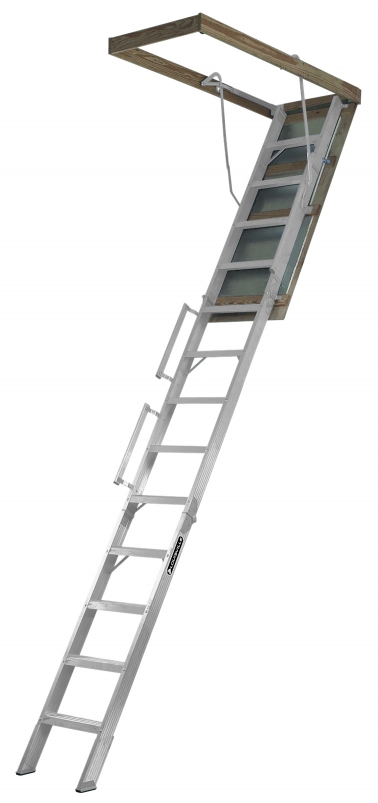
aluminum attic ladder.jpg


Looking to increase your storage options by finishing your underutilized attic? If so, you will appreciate having an attic ladder that’s sturdy and accessible. But how to determine what to look for when shopping for an attic ladder? There are plenty of considerations however that factor into deciding what the best possible ladder is for your home and your specific needs. Whether you are looking for an indoor or garage attic ladder, Creech Ladder has the perfect attic ladder for your needs.

Length & Weight
Attic stairs are sold in different lengths. Be sure to measure the distance from your ceiling to the floor and buy an appropriate size. Attic ladders also come in different weight capacities. As a general rule, the more weight a ladder can hold, the sturdier it is. At the very least, buy a ladder that can handle the weight of the heaviest person who will be using it plus the heaviest load they will be hauling up and down. That may mean that a 250-pound capacity is suitable, but a 300 to 350 pound capacity Iadder are terrific to give you increased peace of mind.

Leading Ladder Manufacturers
Creech Ladder carries both Werner Ladder and Louisville Ladder two of the most prominent manufacturers of folding attic ladders. Ladders from Louisville Ladder are available in wood and aluminum with an up to 350-pound capacity. Louisville Ladder integrates an advanced cylinder design system, substituting the ordinary steel spring, for an easy opening and closing with a quiet and smooth movement. Prices for aluminum and wood ladders with 300- to 350-pound capacities range from about $125. to $350.

At Creech Ladder Center, we care about your safety. We offer a wide variety of ladders from top, trusted manufacturers like Little Giant and Louisville Ladder Company, so you can properly outfit your home or business with the perfect product for your needs. And always remember, “If it’s out of reach, call the folks at Creech!”

Call Us! 615.242.8601

To learn more about special offers and updates, click here: http://web.vanandtruckequipmenttn.com/home/

Thursday, May 21, 2015

How to Select Your Ladder: Step Ladders & Platform Ladders

ap5008.jpg

The Aluminum Mobile Platform Ladder 300 lb Rated Louisville Ladder AP5000 Series


Which ladder is right for your job?
You’ll save time and energy and reduce your risk of injury if you know how to select the correct ladder for the job. Key factors to consider are type and style of ladder, ladder length, duty rating, and the material from which the ladder is constructed.

Step Ladders & Platform Ladders
Step ladders, and their close cousins, platform ladders, are the most commonly used ladder in the industry. In contrast to extension ladders, step ladders and platform ladders are self-supportable, which means they do not need to be leaned against any type of support to be used. As such, they may be used in the middle of the room, underneath a tree for trimming or a variety of other locations where support for an extension ladder is an issue. There are two major varieties of step ladders; the first is a simple front step ladder. On the front step ladder you will find rungs on one side of the ladder and the other side is designed only for support and is not to be climbed on. The more popular variety is the twin step ladder which provides rungs on either side of the ladder allowing you to climb up whichever side is more convenient and allows you and a friend to climb the ladder simultaneously.

Step Ladder Safety
  • Never use the top or top step of a stepladder as a step without the secure addition of a professional safety cage on a compatibly designed step ladder
  • Never use cross bracing on the rear section of step ladders for climbing unless the ladders are designed and provided with steps for climbing on both front and rear sections
  • Metal spreader or locking devices must be provided on stepladders to hold the front and back sections in an open position when ladders are being used

Step Ladder Height Guide
LADDER SIZE
*HIGHEST STANDING LEVEL (APPROX)
MAXIMUM REACH
4’
1’ 11”
8’ 6”
5’
2’ 10”
9’ 5”
6’
3’ 9”
10’ 4”
8’
5’ 8”
12’ 3”
10’
7’ 7”
14’ 2”
12’
9’ 6”
16’ 1”
*Based on a 5’7” user with a 12” reach

Platform Ladders
A platform ladder is a front step ladder with a platform as its top step.  A top rail guard is usually around two feet higher than the platform to provide safety while you are working.  Platform ladders provide that higher level of comfort you look for while standing on a ladder for any amount of time.  You won’t be killing the bottom of your feet or your shins when you stand on the platform.  This ladder allows you to work on any project that requires you to use two hands as safely as if you were on the ground itself.  Being able to rotate around and work in which ever direction you need helps you to work safer and faster.

Good, sturdy step ladders and platform ladders are indispensable tools for many service trade professionals, like painters, builders and remodelers, firefighters, and many many more. If you’re considering stepping up the quality of your equipment, or maybe it’s simply time to replace your old, well-worn favorites, Creech Ladder has everything you need to succeed.

Stay tuned for more useful industrial ladder types in our next post. To learn more about ladders, scaffolding, and a wide array of service industry equipment available for your vehicles and more, check out Creech Ladder. We're your one-stop-shop for accessories that improve safety, stability and usability. You can call us direct at 615.242.8601, or check out our website for special offers and updates at: http://web.vanandtruckequipmenttn.com/home/.

And remember,  if it's out of reach, call the folks at Creech!

Friday, May 8, 2015

How to Select Your Ladder: The Extension Ladder

image010.jpg

Which ladder is right for your job?
You’ll save time and energy and reduce your risk of injury if you know how to select the correct ladder for the job. Key factors to consider are type and style of ladder, ladder length, duty rating, and the material from which the ladder is constructed.

Choose the right type and style
Most portable ladders are either non-self-supporting, such as an extension ladder, or are self-supporting, such as a standard step ladder. But there are also combination ladders that quickly convert from a stepladder to an extension ladder. You’re likely to find the right size, shape, and type of ladder to accomplish your task within one of these categories. This week we take a look at one of the most commonly used ladder for industrial application: the extension ladder.

Extension ladders - non-self-supporting
Extension ladders offer the greatest length in a general-purpose ladder. The ladder consists of two or more sections that travel in guides or brackets, allowing adjustable lengths. The sections must be assembled so that the sliding upper section is on top of the lower section. Each section must overlap its adjacent section a minimum distance, based on the ladder’s overall length. The overall length is determined by the lengths of the individual sections, measured along the side rails. The table below shows the minimum overlap for two-section ladders up to 60 feet long.

LADDER LENGTH
OVERLAP
Up to 36 feet
3 feet
36 to 48 feet
4 feet
48 to 60 feet
5 feet

Most extension ladders are made of wood, aluminum, or reinforced fiberglass. Wood ladders can’t have more than two section and must not exceed 60 feet. Aluminum and fiberglass ladders can have up to 3 sections; however, the overall length must not exceed 72 feet. Individual sections of any ladder must not be longer than 30 feet. Extension ladders can be used only by one person at a time.

Is it necessary to “tie off” an extension ladder to prevent it from slipping?
It is not necessary to tie off the ladder, but you must ensure that the ladder cannot be accidentally moved or displaced. Thoroughly inspect your ladder to be certain all aspects are in top working condition, especially the footings and the rung locks.

We’ll cover other types of ladders in our next post. To learn more about ladders, scaffolding, and a wide array of service industry equipment available for your vehicles and more, check out Creech Ladder. We're your one-stop-shop for accessories that improve safety, stability and usability. You can call us direct at 615.242.8601, or check out our website for special offers and updates at: http://web.vanandtruckequipmenttn.com/home/.

And remember,  if it's out of reach, call the folks at Creech!

Tuesday, April 21, 2015

Don't Take Chances with Your Safety!


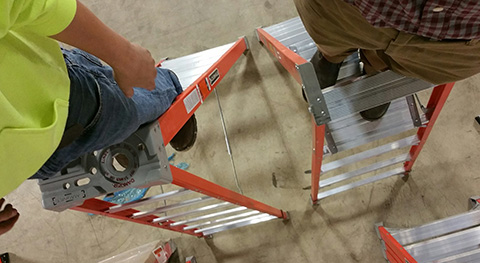
Spotting-Safety-Self-Supporting-Ladder-Blog-photo-4.7


The LADDER:
One of the most dangerous and frequently misused tools at the jobsite.

Oh. My.
You’ve seen it before. You may have chuckled a bit, shaking your head at the bravado of the risktaker upon the rungs. You may have scolded them, hoping to persuade them to put an end to their risky business. Or you may have even been the one atop the ladder, gambling your personal safety for the sake of time, convenience, or the cost of the right ladder or scaffolding system for the job. Looking back, was it worth it?

Was it worth it?
The answer to that question likely depends upon which side of the statistics you fall upon.  OSHA tells us that approximately 25,000 people suffered ladder related injury falls last year.
Working with heights creates special risks. When person falls even a few feet off a ladder and lands on a hard surface, like concrete, the injuries will often be severe. Ranging anywhere from bruising & soreness to joint & fracture injuries, back & neck injuries, and brain injuries, falls from heights almost always result in work stoppage, lost wages, and may be career ending or even fatal. According to data published by the CDC, 43% of fall fatalities are ladder falls.

Familiarity breeds contempt?
When it comes to ladder safety, regular usage has been shown to have a direct correlation with an individual’s likeliness to “get creative”, disregarding proper operational standards and limitations. As mentioned earlier, tight spots, time constraints, and improper budget also play a major role in users’ poor decision making when it comes to ladders.

7 keys to ladder safety:
  1. Proper training
    • Before initial operation, be sure your team has been properly trained on safety and correct ladder usage.
  2. Proper usage:
    • Secure the ladder
    • An extension ladder should be tied off at the top, middle and bottom
    • The structure that you tie the ladder to must be capable of supporting the ladder.
    • The top must extend three feet beyond the roof line if you are climbing onto the structure.
    • The ladder must extend three feet past the platform being climbed to if climbing to another surface.
    • Always face the ladder when climbing or descending.
    • Do not climb higher than the second rung on stepladders or the third rung on straight or extension ladders.
    • Hands must be free of material while climbing ladders. Hand lines and/or tool pouches will be used to raise or lower material.
    • Utilize the 4-1 ratio:
      • Divide the length of the structure from the ground to the top support point (where the ladder rests against the building) by four - not including the three foot extension to 15 feet.
      • The ladder’s base should be three feet from the foundation.The 4-to-1 Ratio is important because the angle it creates utilizes the ladder’s strength and gives optimum balance when climbing.
  1. PPEs (Personal Protective Equipment)
    • These vary with the job, but include things like
      • Body harness - especially for greater heights
      • Safety helmet - to protect against head trauma
      • Work gloves - for increased grip
      • Work shoes or boots - for increased grip and flexibility
  2. Proper equipment maintenance
    • Ladders should be inspected before and after each use. Look for:
      • Broken or frozen joints or latches.
      • Cracks, broken welds, rough spots and burrs.
      • Cracked wood, splinters, and rot.
      • Broken or loose hardware.
      • Protect wood ladders with linseed oil or clear sealant.
      • Protect fiberglass ladders also with a clear sealant.
      • Frequently oil metal bearings of locks, wheels, pulleys and other moving parts.
  3. Safe working environment
    • The ladder foundation and top point of contact (for extension ladders) should be clear and secure, with no obstructions or barriers to maximum traction.
  4. Accountability
    • Friends don’t let friends take dangerous chances. Work to establish a zero-tolerance policy regarding not following proper ladder safety practices among the team.
  5. Proper equipment
    • The right size and type of ladder for the job can be a lifesaver. Literally.

At Creech Ladder Center, we care about your team’s safety. We offer a wide variety of ladders from top, trusted manufacturers like Little Giant and Louisville Ladder Company, so you can properly outfit your team with the right equipment for the job. The next time you find yourself in a tight spot with inferior equipment, just remember, “If it’s out of reach, call the folks at Creech!”

Call Us! 615.242.8601

To learn more about special offers and updates, click here: http://web.vanandtruckequipmenttn.com/home/

Wednesday, April 8, 2015

The Ladder


Photo Credit: "Hausbuch Wolfegg 53v 53v1 Drehbank Waage Steiggeräte" by Anonymous

noun, lad·der often attributive \ˈla-dər\
 
: a device used for climbing that has two long pieces of wood, metal, or rope with a series of steps or rungs between them.
: a series of steps or stages by which a person is enabled to move up to a higher or better position.


Everyone knows the purpose of a ladder is to reach high, otherwise out of reach places safely. But there are a few things you may not know about this oft overlooked tool. Here is a short list of historical tidbits about the mighty ladder.
  • Scientists believe ladders to have been used over 10,000 years ago due to depictions of them in ancient Mesolithic era paintings discovered in the Spider Caves in Spain. 
  • This early ladder as painted is long and flexible, and is made of a material with the appearance of grass.
  • Some of the oldest ladders on record were not made of fixed materials, but with flexible fibers like rope. A small number of these historic ladders are still in use today. 
  •  The bible famously makes mention of "Jacob's Ladder" in Genesis 28:10-19. In the scripture Jacob describes a dream in which he saw a ladder reaching from heaven to earth with angels ascending and descending it. The book of Genesis is believed to have been written somewhere between 1440 and 1400 B.C.
  • On January 7, 1862, Dayton, Ohio resident John H. Balsley received the first US patent for the step ladder. While not the original inventor, Mr. Balsley improved upon the design by placing hinges atop of the ladder, allowing it to be folded and more easily stored and transported. 
  •  Kiva ladders, originally used to reach the upper floors of the Anasazi cliff dwellings, southwestern pueblo homes, and ceremonial caves, are a primitive looking wooden ladder made of tall, hand-scraped pine poles. Scaled down replicas have become a popular item in contemporary home decor.
  • Deteriorated or improperly fitted base pads are one of the most common causes of ladder slippage contributing to accidents. They are responsible for lowering friction with the ground, thereby increasing traction. Ladder stabilizers are widely available and do much to increase a ladder's grip on its foundation. The first ladder stabilizers or ladder feet were offered in 1936 and today are standard equipment on most large ladders.
To learn more about ladders, scaffolding, and a wide array of service industry equipment available for your vehicles and more, check out Creech Ladder. We're your one-stop-shop for accessories that improve safety, stability and usability. You can call us direct at 615.242.8601, or check out our website for special offers and updates at: http://web.vanandtruckequipmenttn.com/home/.

And remember,  if it's out of reach, call the folks at Creech!

Tuesday, March 31, 2015

Dress Your Fleet for Success!

Take 20% off all in-stock Tradesman & Lund Toolboxes!

 (limited time offer)

If you’re like me, your heart beats just a little faster at the smell of rubber and the sight of metal. Argh-ha-ha: tools! If you take pride in knowing you can get the job done, and get it done right, then you probably know the value of the right tool for the job. And not just any “right” tool: it’s got to be quality. Otherwise, what’s the point?

Take for example the Aluminum Diamond-Plate Flushmount Toolbox by Tradesman pictured above. Boy, she’s a beauty, isn’t she? Like jewelry for your truck. And functional? This toolbox is not only great-looking, but will pay for itself many times over a lifetime of service. If you’ve ever had one, you know what I mean.

It feels good to invest in yourself, and your company, knowing you’re about to take another important step up in your business. If dressing for success is the key to making an excellent first impression, maybe it’s time to dress your fleet for success?

Here’s a list for starters: truck bed boxes, toolboxes, covers, and racks; van shelving, partitions, & tool chests; ladder racks and material racks for all kinds of vehicles - and that’s to say nothing of the ladders themselves. Fiberglass, aluminum, wood; attic ladders, rolling stock ladders, scaffolding, and walk boards. Creech Ladder is proud to bring you top of the line products at affordable prices.

Shop our website’s extensive product catalogs, from outstanding outfitters like Louisville Ladder, Kargo Master, Little Giant, and others. We’ve got what you need to suit up and get the job done. Creech Ladder carries a great selection of van and truck conversion packages and components for First Responders, HVAC, Roofing, and Painting Specialists, and many many more.

Check us out! Creech Ladder has everything you need. We ship within Tennessee, Kentucky, Georgia, Arkansas, Alabama, Mississippi, South Carolina, North Carolina, Virginia, and just about anywhere in the United States from our catalog.
And remember, if it’s out of reach, call the folks at Creech!

2507 Nolensville Pike, Nashville, TN 37211 | (615) 242-8601 | http://www.creechladder.com

Monday, February 16, 2015

Home and Building Maintenance Season is in Full Swing!


Spring is in the air, and that means home and building maintenance season is in full swing! There’s nothing more important than having the right tool for the right job. At Creech Ladder, we offer a wide variety of top-of-the-line ladders and scaffolding for all your projects, whether personal or professional.
Contractors, if it’s time to step up to the next level by fully equipping your fleet, Creech Ladder will help you outfit your professional trucks and vans with transit shelving, ladder racks, material storage and accessories specially designed for your vehicles. Your business deserves an investment that pays for itself in safety and efficiency.
Spring is also a great time to inspect and inventory your existing equipment. Are the scaffolding and ladders you’ve depended on for so long still up to par? Safety is very important. Taking preventative measures to keep yourself or your employees safe is not only smart and responsible, but saves money. Injury accidents from ladder and scaffolding falls can be devastating. Speaking of safety, don’t forget to take advantage of our ladder training program from Louisville Ladder, C.L.I.M.B. Academy. This 58 page, bilingual training document is a comprehensive guide for professional practitioners as well as weekend warriors.
From attic ladders to commercial scaffolding, Creech Ladder has everything you need. A family-owned and operated business serving Middle Tennessee since 1987, Creech Ladder has a well-earned reputation for personal service and quick turnaround. We ship within Tennessee, Kentucky, Georgia, Arkansas, Alabama, Mississippi, South Carolina, North Carolina, Virginia, and just about anywhere in the United States from our extensive product catalog.
Creech Ladder is one-stop shopping for all your ladder, scaffolding & accessories needs. Remember, if it’s out of reach, call the folks at Creech!

2507 Nolensville Pike, Nashville, TN 37211 | (615) 242-8601 | http://www.creechladder.com